
New Books by Canadian Law Faculty Members
New Books by Canadian Law Faculty Members
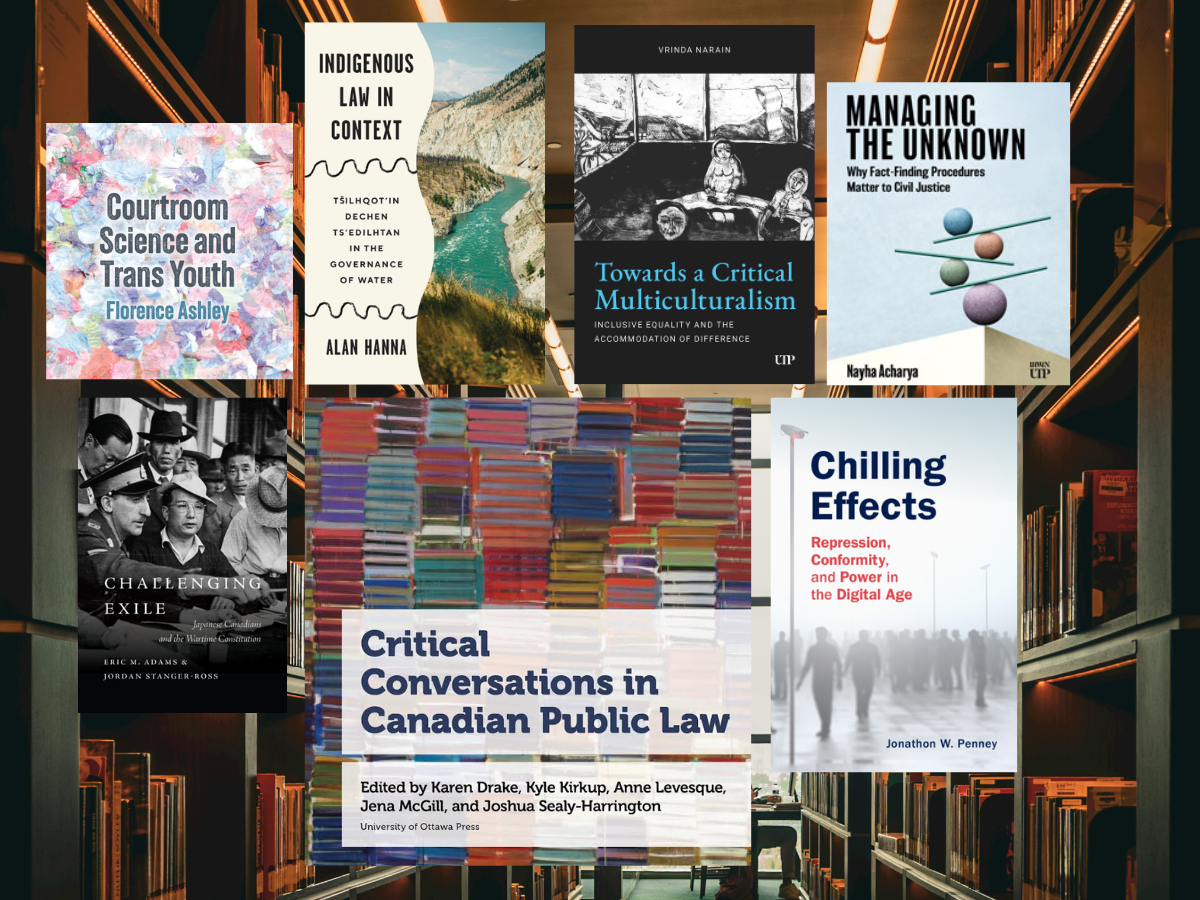
Alan Hanna, Indigenous Law in Context: Tŝilhqot’in Dechen Ts’edilhtan in the Governance of Water (UBC Press)
Eric M. Adams & Jordan Stanger Ross,Challenging Exile: Japanese Canadians and the Wartime Constitution (UBC Press)
Florence Ashley, Courtroom Science and Trans Youth (UTPress)
G.J. Reynolds, A. Mogyoros, & T. Dagne., eds, Intellectual Property Futures: Exploring the Global Landscape of IP Law and Policy (University of Ottawa Press, 2025)
Jeffery G. Hewitt, Beverly Jacobs and Richard Moon, Indigenous Spiritualities and Religious Freedom (UTP 2025)
Jonathan Penney,"Chilling Effects: Repression, Conformity, and Power in the Digital Age" (Cambridge UP, 2025).
Jena McGill, Karen Drake, Kyle Kirkup, Anne Levesque and Joshua Sealy-Harrington, Critical conversations in Canadian public law. Ottawa, Ontario : University of Ottawa Press, 2025
Nayha Acharya, Managing the Unknown: Why fact-finding procedures matter to civil justice (UTPress)
Vrinda Narain, Towards a Critical Multiculturalism: Inclusive Equality and the Accommodation of Difference (UTP 2026)
Update on Intervention in FOI matter
As we told you here, CALT (along with the Faculty Association of the University of Calgary, and the Canadian Association of University Teachers) intervened in an appeal to the ABCA of an FOI related order from the ABKB.
The decision in Governors of the University of Calgary v Alberta (Information and Privacy Commissioner), 2025 ABCA 350 was released October 28 2025.
ACPD-CALT is delighted to see that the Justices of the Court of Appeal included the following paragraphs in closing, addressing ACPD-CALT's main concern with the ABKB decision:
[40] However, the justice did make obiter comments about the professors’ complaint itself. The Adjudicator had rejected the requestor’s argument that activism could not constitute research information. The justice opined that a distinction should be drawn between academic study of social activism and direct participation in social activism and that participation would be excluded from the definitions in question. The parties to this appeal and the intervenors take the position that this distinction may well lead to arbitrary results. The intervenors propose an analytical framework.
[41] We agree that academic freedom exists to protect all scholarship, including that which may be unpopular or politically targeted. A distinction between participation in activism and study of activism may lead to definitions of “teaching materials” and “research information” which exclude novel teaching methodologies, teaching and research activities on particular topics involving what might be construed as participation in activism, and other direct engagement in the community outside the traditional classroom setting, as well as an academic’s participation relating to responsibilities or duties at their post-secondary institution.
[42] Subject to this proviso regarding the justice’s obiter comments, we conclude that the justice did not err in finding the Adjudicator’s decision to be unreasonable, nor in remitting the matter back to a different adjudicator with direction to consider the request afresh.
[43] Again, the justice did not define the terms in question but provided considerable guidance in his written decision regarding the context and purposes behind the exclusions. He observed that academic freedom and excellence are essential to our continuance as a lively democracy, citing McKinney v University of Guelph, 1990 CanLII 60 (SCC), [1990] 3 SCR 229 at para 69. He referred to the following definition of “academic freedom” from the Canadian Association of University Teachers (CAUT) Policy Statement on Academic Freedom, November 2011:
Academic freedom includes the right, without restriction by prescribed doctrine, to freedom of teaching and discussion; freedom in carrying out research and disseminating and publishing the results thereof; freedom in producing and performing creative works; freedom to engage in service to the institution and the community; freedom to express freely one’s opinion about the institution, its administration, or the system in which one works; freedom from institutional censorship; freedom to acquire, preserve, and provide access to documentary material in all formats; and freedom to participate in professional and representative academic bodies. Academic freedom always entails freedom from institutional censorship.
See also The Faculty Association of the University of Calgary’s Statement on Research Information of an employee of a post-secondary educational body in the Freedom of Information and Protection of Privacy Act, November 5, 2021. Other relevant considerations include the importance of fostering competition in academic research and teaching within and between educational institutions; encouraging collaborative academic environments, which may include collaboration with others outside the academic institution; protecting the process of creating teaching materials and research information; and respect for institutional autonomy.
ACPD-CALT would like to express our gratitude to
- Sean Fluker, also a Professor at University of Calgary and Executive Director of the Public Interest Law Clinic, supported CALT's efforts and has done a great deal of work on this file.
- Counsel for the Faculty Association, Kelly Nychka and Camila Franco of Chivers Carpenter, who brought the case for the joint intervenors.
- CALT Board member Richard Devlin, who has been heavily involved in the work, and our President, Graham Reynolds for his championing of this cause.
See the Memorandum of Argument of the intervenors and the ACPD-CALT President's Affidavit below.
Case history: Decision of the Information and Privacy Commissioner: University of Calgary (Re), 2022 CanLII 76344 (AB OIPC), <https://canlii.ca/t/jrlfx>, appealed and returned for decision by a new Adjudicator, properly informed: Governors of the University of Calgary v Alberta Information and Privacy Commissioner, 2024 ABKB 522 (CanLII), <https://canlii.ca/t/k6lb8>.
Gen AI Research Survey to circulate to english speaking students in Canadian Law Schools
Application to Intervene by CALT in FOI matter
As discussed at our AGM, ACPD-CALT has applied to intervene in an FOI issue in the Alberta courts. The Board believes this case raises issues about the unique status, role and expertise of law professors, and the scope of our role as researchers and educators in the public interest. In particular, our read of the last few paragraphs of the case suggests a cabining of the scope of research that does not reflect the contemporary understanding and practice of research by law professors across the country. This is, as far as we know, ACPD-CALT's first application to intervene in the organization’s long history.
Read more
With Thanks: Craft, Calling, Community: Usask 2025
Thanks to everyone who joined in ACPD-CALT's 2025 meeting at the Unversity of Saskatchewan College of Law in Saskatoon - three days filled with learning, connecting and engaging, - and more for those continuing with the CLSA meetings ending today.
Special thanks to Katie Richard (Alumni Relations and Event Coordinator at the College of Law) who expertly managed the entire event and USask Law Dean Martin Phillipson for his enthusiastic idea that we would all descend on Saskatoon.
We are indebted to Associate Dean Heather Heavin for local host work, and USask faculty members Jamesy Patrick and Sarah Buhler for planting the idea while CALT was in Fredericton with UNB in 2024.
Elder Joseph Naytowhow opened the event with a smudge and teachings in the Medicine Garden, beside the school, managed by the Indigenous Law Centre, reminding us of the relationships between land and people, land and language, and land and law. The tipi on the grounds of the College of Law houses a newly built sweatlodge, made of seventeen red willow trees. Together with Elder Julie Pitzel, Joseph closed the conference with song and stories of their long relationship, their work together, the way that relationships live in people - and some of the dangers of documentation and diagnosis. The warm generosity and welcome extended to us through these teachings called us to the work of reconciliation and the unique responsibilities and legacies of law and law teachers in the ongoing settler/Indigenous relationships. Kinanâskomitinawaw, hiy-hiy, Joseph and Julie.
To all the workers who housed, fed, transported and otherwise supported our visit, thank you. Saskatoon, far to the south of the fires which threatened and consumed homes and communities to the North including La Ronge, Lac La Ronge Indian Band, Lamp Lake, Napatak, Nemeiben Lake, Sikachu and Sucker River, was hazy and smelled of smoke. But people are returning home. The beauty of the place was alive. The Saskatoon Berries baseball team crushed the Medicine Hat Mavericks.
[did your panel have materials that could be posted to the website? let us know by sending to [email protected]]
[do you have pictures of our conference? you can send these to [email protected] and we will add them to this page]
ACPD-CALT Awards 2025
Find more on ACPD-CALT's prizes here. The call usually goes out in December.
ACPD-CALT Prize for the Scholarship of Teaching and Learning: Jaime Lavallee & Robin Hansen


Read more
Rule of law pledge; Human Lawyers; Law Teaching Certificate
Some of you may already have seen this initiative come through your inboxes: The Rule of Law Project (available en francais as well)
".... in recent months we have seen how fragile the Rule of Law can be and how quickly it can be eroded. Could the Rule of Law be attacked and eroded in Canada? The answer is yes, it could. The Rule of Law, like democracy itself, is more than a concept or ideal. Its very existence depends on the purposeful actions of government and citizens alike. The Rule of Law and democracy both require action.
These questions prompted a conversation between a small group of lawyers and academics about what we Canadians can collectively do to protect, promote, and nourish the Rule of Law here in Canada. While there will be more to come, we thought we could start with this simple idea: Canadian lawyers should unite and collectively pledge to uphold the Rule of Law. "
Legal Education and the Human Lawyer Symposium June 27 entirely online/registration is free for this session, held by Osgoode OPD and sponsored by the Association of Law Teachers UK and "The Law Teacher" publication. Many ACPD-CALT members presenting on the schedule! Click here to learn more and register.
Also at Osgoode Professional Development (but online), another round of the Osgoode Certificate on Law Teaching is coming up: click here to see more about this five day online program, taught through three modules:
Module 1: Foundations of Law Teaching
October 24, 2025 – 1:00 p.m. – 4:00 p.m.
October 25, 2025 – 9:30 a.m. – 4:30 p.m.
Introduction to Learning Design
Assessment and Feedback
Indigenization and Legal Education
Equitable, Inclusive, and Culturally Responsive Teaching Practices
Accessibility
Managing the Classroom
Module 2: Law Teaching with Problems and Projects
November 8, 2025 – 9:30 a.m. – 5:00 p.m.
Introduction to Problems and Projects
Simulations
Teamwork
Teaching with Problems and Projects: Case Studies
Asynchronous Workshop: Creating a Problem or Designing a Project
Module 3: Special Topics in Law Teaching
November 28, 2025 – 6:00 p.m. – 8:00 p.m.
November 29, 2025 – 9:30 a.m. – 4:30 p.m.
Law Teaching and AI
Lecturing in Law Teaching
Advanced Assessment
Teaching Law Online
Trauma-informed Practices in Law Teaching
ACPD-CALT IP & Tech Doctoral Student Research Roundtable /;Table ronde sur la recherche des doctorants
ACPD-CALT Doctoral Student Research Roundtable (Intellectual Property and Technology Law) / Table ronde sur la recherche des doctorants (Droit de la propriété intellectuelle et de la technologie)
Dear Colleagues,
On Thursday, April 3rd, ACPD-CALT will host an online doctoral student research roundtable, for students whose work engages with intellectual property and/or technology law. This event, which will take place by Zoom, will provide an opportunity for doctoral students at Canadian institutions whose work focuses on these areas to share their research with both fellow doctoral students as well as with faculty members. Each student will have 15 minutes to present their work, after which there will be a short Q&A.
The list of participants is as follows:
- Kow Abekah-Wonkyi
- ‘Damola Adediji
- Chinenye Eze
- Margot Gunning
- Oludolapo (Dolapo) Makinde
- Rowan Meredith
- Anmol Patel
- David Watson
Here is the event schedule (all times Pacific):
- 9-10:30: First four presentations including Q&A
- 10:30-10:45: Wellness break
- 10:45-12:15: Final four presentations including Q&A
Should you be interested in attending, please register at the following link:
(It’s not necessary to register if we’ve previously communicated about the event.)
I’ll send along the Zoom link to all confirmed participants the day before the event.
Thanks for considering this invitation and all best wishes for the end of term!
Graham
-----
Chers collègues,
Le jeudi 3 avril (2025), l'ACPD-CALT organisera une table ronde en ligne sur la recherche des doctorants, pour les étudiants dont les travaux portent sur la propriété intellectuelle et/ou le droit de la technologie. Cet événement, qui se déroulera via Zoom, offrira l'occasion aux doctorants des établissements canadiens dont les travaux portent sur ces domaines de partager leurs recherches avec leurs collègues doctorants ainsi qu'avec les membres du corps professoral. Chaque étudiant disposera de 15 minutes pour présenter son travail, après quoi il y aura une courte séance de questions-réponses.
Liste des participants:
- Kow Abekah-Wonkyi
- ‘Damola Adediji
- Chinenye Eze
- Margot Gunning
- Oludolapo (Dolapo) Makinde
- Rowan Meredith
- Anmol Patel
- David Watson
Calendrier des événements (fuseau horaire du Pacifique):
- 9-10:30: Les quatre premières présentations, y compris les questions et réponses
- 10:30-10:45 Pause bien-être
- 10:45-12:15: Les quatre dernières présentations, y compris les questions et réponses
Si vous souhaitez y assister, veuillez vous inscrire via le lien suivant:
(Il n’est pas nécessaire de s’inscrire si on a déjà communiqué sur l’événement.)
J'enverrai le lien Zoom à tous les participants confirmés la veille de l'événement.
Merci d'avoir tenu compte de cette invitation et de tous mes vœux de fin de trimestre!
Graham
CFP Legal Education and The Human Lawyer
CALL FOR PAPERS
Legal Education and the Human Lawyer
June 27, 2025
9:30 am – 3:00 pm ET (online)
Submission Guidelines
Interested participants are invited to submit a paper abstract of no more than 250 words by
11:59 pm ET on April 17, 2025 to https://app.oxfordabstracts.com/stages/78405/submitter.
Submissions from thoughtful scholars at all levels are welcome. Selected participants will be notified in
early May.
In a world of rapidly developing artificial intelligence, the theme for this research symposium will be
legal education and the human lawyer. Participants will engage with the twin questions, what is unique
and important about human legal expertise, and how should legal education support students in
developing these capacities?
The legal profession is in a moment of profound anxiety about the potential for artificial intelligence to
displace much of the work of lawyers. As legal educators, it is incumbent on us to explore and study the
uniquely human aspects of legal expertise and to ensure that we provide a legal education that will
ultimately enable students to help their clients and contribute to their communities and society in ways
that artificial intelligence cannot. This event will provide a forum for these early-stage discussions and,
hopefully, provide a foundation for continued study, reflection, and active experimentation in legal
education, including informing decisions about how and why to engage students in using generative AI
tools.
The symposium will offer three provisional sub-themes that contributors will be asked to engage with in
any way they wish. The themes describe non-exclusive and overlapping aspects of human legal expertise
that, it is hypothesized, will continue to be important.
1. Sense making:
Human lawyers will continue to be needed to make sense of the complex legal problems faced by
individuals, organizations, and society, and to exercise judgement in creating strategies or solutions
for these problems. In other words, human sense-making will be crucial in both framing complex
problems and in working to resolve them. As Schön argues in the context of another
profession, where “[p]roblems are interconnected, environments are turbulent, and the future is
indeterminate ... [w]hat is called for ... is not only ... analytic techniques ... but the active, synthetic
skill of ‘designing a desirable future and inventing ways of bringing it about.’”
2. Human values:
Human lawyers will continue to be essential in bringing human values to bear in the use of law to
structure human relationships at the level of individuals, communities, and society. Part of the work
of lawyers has always been to exercise ethical judgement in selecting from a range of possible
solutions to legal problems. This will be even more crucial in working with technology. In particular,
critical perspectives point to the importance of investigating the values embedded in technological
tools, including whose values are privileged and whose values are excluded.
3. Human connection:
Legal work is much more than simply providing legal information and solving technical legal
problems. Particularly in working with individual clients, but also in serving organizations and
communities, good lawyers are adept at connecting with others to support, counsel, guide, and create.
As Gowder explains, the non-cognitive aspects of legal work are particularly critical for those
who are already disadvantaged. However, this aspect of human legal expertise will continue to be
important to a wide range of people, organizations, and communities that seek the help of lawyers.
As Furlong argues, people will continue to come to human lawyers for their “insight, counsel, and
honesty,” asking: “What do you think I should do?” “What does the best course of action seem
like?” “Will you help me navigate that course?” “Will you speak to others for me?” “Will you deal
with others on my behalf?” “Will you accompany me on my journey?”
Papers from this symposium may be considered for a special issue of The Law Teacher.
Submission Guidelines
Interested participants are invited to submit a paper abstract of no more than 250 words by
11:59 pm ET on April 17, 2025 to https://app.oxfordabstracts.com/stages/78405/submitter.
Submissions from thoughtful scholars at all levels are welcome. Selected participants will be notified in
early May.
Optional Pre-Submission Workshop
An optional and very informal pre-submission workshop will be held online on March 28, 2025 from
12:00 – 1:00 pm ET. Join us to discuss your paper ideas, or submit an abstract in advance of the
workshop for review and discussion with other participants in a supportive environment. All are
welcome. Please register for the workshop at https://machformopd.osgoode.yorku.ca/ext/view.php?id=515545.
Contact Information
For any questions about the call for papers or the pre-submission workshop, please contact Audrey
Fried at [email protected].
This symposium is funded through a grant from the Association of Law Teachers and The Law Teacher,
and co-sponsored by Osgoode Hall Law School and Osgoode Professional Development.
AGA/AGM
Add to your calendar/Ajouter à votre calendrier
AVIS OFFICIEL DE L'ASSEMBLÉE GÉNÉRALE ANNUELLE/ OFFICIAL NOTICE OF ANNUAL GENERAL MEETING
VEUILLEZ NOTER QUE l'Assemblée Générale Annuelle de l'Association canadienne des professeur(e)s de droit aura lieu le / TAKE NOTICE that the Annual General Meeting of Canadian Association of Law Teachers will be held on
Jeudi le 30 mai 2024, à 12 :45 ADT / Thursday May 30 2024 at 12:45ADT
University of New Brunswick Faculty of Law
OR/OU
via Zoom Internet Meetings (register/s'inscrire)
You must register in advance for this meeting to receive a zoom link via email.
Merci de vous inscrire à l'avance. Vous recevez ensuite un e-mail avec un lien “zoom”.
11:45 am EDT 10:45 am CDT 9:45 am MDT 8:45 am PDT
Job Opportunity: Graduate School of International Studies at Laval University
The Graduate School of International Studies at Laval University is seeking a PROFESSOR IN GLOBALIZATION ISSUES
The Graduate School of International Studies at Laval University (Quebec City, Canada)
is currently seeking a professor working in a multidisciplinary approach on globalization
issues. Multilateral governance of trade; regional economic integration partnerships;
combating inequalities on an international scale; links between trade and development;
reconciling freedom of trade with environmental, health, social, and cultural issues;
development and implementation of national trade policies; combating climate change and
policies for adapting to these changes; challenges related to agricultural trade; phenomena
of protectionism, precautionism, and friend-shoring; inclusive and sustainable trade; ecommerce
and cybercrime; and more generally, green, digital, and security shifts that
today’s global economy is undergoing are examples of themes that the Graduate School is
interested in.
Allard UBC 2024-2025 Global South Visiting Scholar In-Residence Deadline: May 31, 2024
"The successful Global South Visiting Scholar (GSVS) will spend a minimum of two weeks and maximum of three months in residence at the Peter A. Allard School of Law. For this iteration of the program, the GSVS must be able to complete this opportunity either between September-November 2024, or during the 2025 calendar year. In order to facilitate active participation in the Law School community, the GSVS must arrange to be in residence during Allard’s academic year, namely September-November 2024, January-March 2025, or September-November 2025. Preference may be given to candidates who are able to attend during the September-November 2024 or January-March 2025 terms. As part of their visit, the GSVS is expected to give lectures, hold sessions with faculty and graduate students, and conduct independent research. The ideal candidate will be an early to mid-career scholar."
Final Report and Recommendations National Requirement Review accepted by the Council of the Federation
The Final Report was released recently (here in English, here in French) and changes to the National Requirement have already been approved by the Council of the Federation. The final Report does not differ significantly from the early drafts. CALT's comments to the NRRC throughout this review process can be found here.
We are looking forward to further discussion with members and others on the changes, implications, process and in particular perhaps the suggestion of a Forum on Continuum of Legal Education which is apparently being discussed between the Federation and the Canadian Council of Law Deans (see para 112 et seq of the Report).
Lakehead Law Journal CFP
October 2023
The Lakehead Law Journal is a refereed, open access journal that publishes articles, case comments, book reviews, and book notes on legal issues in Canada. The LLJ is run by an Editorial Team made up of both students and faculty, with Professor Tenille E. Brown serving as Editor-in-Chief.
Call for Submissions
The LLJ is pleased to invite submissions for our next issue. The LLJ fills a significant niche in the legal scholarship landscape by focusing on the following mandates: (1) Aboriginal and Indigenous legal issues; (2) rural, northern, and small firm practice; and/or (3) natural resources and environmental law.
We also publish papers that are shorter than typical academic articles. Our hope is that shorter pieces (7000 words) will be more accessible to busy lawyers and judges, making them more likely to be cited in judgments and play a part in shaping the law. We invite you to view our latest publication Volume 5 Issue 2
Please visit llj.lakeheadu.ca for information on the online submission process, requirements, and journal policies. All new authors seeking to make a submission must register on the site. The registration process is simple and once registered, authors can not only submit work, but also review the status of their submissions.
Any inquiries should be directed to Kyle Morton, Managing Editor (Fall 2023), at [email protected] or to Professor Tenille Brown, Editor-in-Chief, at
The LLJ appreciates all submissions and is committed to providing an update on the status of submissions within six weeks.
Submissions will begin to be reviewed and considered for publication on a rolling basis for annual publication.
Lakehead Law Journal
llj.lakeheadu.ca
ACPD-CALT Response/ réponse: Examen de l'exigence nationale/Review of the National Requirement
Add your reaction ShareBulletin January 2023
Bulletin ACPD-CALT Bulletin
January 27 janvier 2023
...with our warmest wishes for a very happy New Year
....avec nos vœux les plus chaleureux pour une heureuse année 2023
CALT AT CONGRESS May 29, 30 2023 in Toronto:
Registration is now open and the Agenda for CALT's Meetings will be out in late Jan/early February.
CALT.ONLINE IN FEBRUARY AND MARCH 2023
|
Regulation of Lawyers .... and Law Schools? How ongoing debates about lawyer licensing affect law schools and legal education Fri Feb 10 230 PM EST |
| Welcome to the Canadian Legal Academy: Assistant Professors Irina Cerić and Vincent Wong (Windsor Law) |
| Appel a Communications : La Revue de l’enseignement du droit au Canada (REDAC). Call for Contributions Canadian Legal Education Annual Review (CLEAR) |
Professors Backhouse and Arthurs Respond to the FLSC National Requirement Review Committee
Associate or Full Professor Indigenous Faculty Appointment: UBC Allard School of Law Deadline November 5, 2023
National Requirement Review Committee Discussion Paper
On September 26, 2023 CALT held an online discussion forum to discuss the proposals in the National Requirement Review Committee's Discussion paper and to consult about CALT's response to the Federation of Canadian Law Societies.
We urged all attendees to consider the proposals, to let their colleagues know about this, and to consider putting their comments in before the October 16 2023 deadline (send to [email protected]). The Discussion Paper is here (english only). The current version of the National Requirement is here.
More about the National Requirement
"The National Requirement, developed by the Task Force on the Canadian Common Law Degree (“Task Force”), was adopted by the Council of the Federation in 2009 and approved by Canada’s law societies in 2010. ....
The National Requirement specifies the skills and competencies required of both domestically and internationally trained graduates to be eligible for bar admission programs and establishes criteria for assessing proposals for new law school programs in Canada. ...
The Council of the Federation established the Canadian Common Law Program Approval Committee (“Approval Committee”) in 2012, with a mandate to assess compliance with the National Requirement....
(see National Requirement Review Committee Discussion Paper 2023 here 11)
Summary of FLSC Proposals
(click here for a ppt of these slides to use, share, download)
ACPD-CALT continues work on our response to the FLSC which will be posted once submitted. You can see some of the earlier correspondence with the FLSC during this Review round, here:
CALT's June 2023 Letter
CALT'S December 2022 Letter
Call for papers for RDUS special issue: Law and Technology (Nov. 15, 2023)
h/t Prof. Andréanne Malacket
Editor R.D.U.S.
Call for papers: Law and Technology (special issue to be published in the Winter of 2025)
pdf Appel de textes en francais
The Revue de droit de l’Université de Sherbrooke (RDUS) is launching a general call for papers on the theme of Law and Technology. New technologies, in particular artificial intelligence (AI) and robotics, have come to dominate our daily activities. Autonomous vehicles, agents and weapons, mass surveillance, robot-judges, targeted advertising, conversational agents and social networks are all implicated by this emerging trend. TheChatGPT conversational tool, developed by OpenAI, has sparked debate about the benefits and risks of AI systems on a societal scale.
The increasingly widespread use of these new technologies has prompted new ways of thinking about, and shaping, the law. At the federal level, Bill C-27 proposes a framework for AI, raising questions about both the substance of the related legal rules and constitutional jurisdiction. In the absence of specific regulations for digital practices, other ethical or technical standards – such as the Montréal Declaration for a Responsible Development of Artificial Intelligence (2018) – have become the main source of guidance.
While this type of initiative may counter weaknesses in the current law, such alternative normative instruments can also push the law forward on digital issues – issues that are both extremely diverse and intersecting. For example, how can algorithmic governance be regulated? How can we preserve and encourage digital innovation while also supervising the so-called “responsible” deployment of AI? How can we limit AI’s impact on privacy and other human rights? How can we best frame automated decision-making? Is it possible to counter the “black box” of algorithms with greater transparency? How can we ensure that AI does not rely on discriminatory biases or contribute to the marginalization of vulnerable groups? How does and how will artificial intelligence affect the practice of law and the broader legal profession? What legal or normative frameworks are needed to regulate AI-related products and applications, such as generative AI, robots or other autonomous devices?
Courts, too, have recently embarked on a digital shift. The modernization of the justice system, including the computerization of court registries, raises a number of questions. Is this modernization properly supervised? Can such an initiative promote access to justice? Can the judicial system learn from the experience of the administrative justice system – such as the Tribunal administratif du travail – with regard to the use of technology in proceedings? How should we think about digital evidence? Are the current legal rules found in part in articles 2837 ff. of the Civil Code of Québec and in the Act to Establish a Legal Framework for Information Technology, CQLR, c. C-1.1 adequate for the state of technology in 2023?
The RDUS invites members of the legal community in Canada to submit works on thesecritical issues. We welcome engagement on a range of topics, including but not limited to:
- Access to justice
- Right to privacy and data protection
- Health law
- Environmental law
- Contract law
- Labour and employment law
- Fundamental rights and freedoms
- Private international law
- Ethics and law of artificial intelligence
- Governance and regulation
- Legal interpretation
- Pedagogy and university teaching
- Evidence and civil procedure
- Intellectual property
- Civil liability
- Society and religion
Works should be between 15,000 and 23,000 words in length (inclusive of notes).
They may be submitted by November 15th, 2023, by email to: [email protected].
Works will be selected by Profs. Anne-Sophie Hulin and Charles-Étienne Daniel, in collaboration with Prof. Andréanne Malacket, editor of the RDUS.
Each submission will undergo a double-blind peer review process. Authors must comply with the RDUS editorial policy, available on the Université de Sherbrooke Faculté de droit website: https://www.usherbrooke.ca/droit/recherche/publications/revue-de-droit-deuniversite-de-sherbrooke-rdus.
The RDUS is also proud to announce that the publication of this special issue is made possible by the OBVIA, the ADAJ project, the Chaire-miroir Ottawa-Lyon, the Chaire de recherche I.A. responsible à l’échelle mondiale, the CrRDG and the SoDRUS. A $1,000 “Prix de la Chaire Justice sociale et intelligence artificielle” (Fondation Abeona / ENS-PSL / OBVIA) will also be awarded to the emerging author (student, junior researcher, assistant professor) who publishes the most significant and innovative contribution in this special issue. The recipient will be selected jointly by the scientific directors of the special issue and by the editor of the RDUS, as well as the RDUS scientific committee.
***
The Revue de droit de l’Université de Sherbrooke was founded in 1970 to promote the publication of legal research. The RDUS accepts original texts in both French and English. It also publishes works with a multi-disciplinary scope or that offer a perspective that goes beyond the strict classical framework of legal positivism.
Prof. Andréanne Malacket
Editor, RDUS
Recap: Wellness in Law Schools: Talking about Techniques and Tensions
On June 26 CALT held a Joint online Session with the Association of Law Teachers UK on Wellness. Members are encouraged to submit items of interest on this subject to CALT, and we will work on a repository.
The materials for the session are available as well:
A Resources document linking speaker bios and providing an extensive list of research resources including all those mentioned in the session. This is a google document available for download.
The Draft Guidelines for Mental Wellbeing in Legal Education prepared by Dr. Emma J. Jones, Sr. Lecturer and Director of Student Wellbeing at University of Sheffield School of Law UK, Professor Caroline Strevens, University of Portsmouth, Professor Rachael Field, Bond University, Australia; and Dr Colin James, ANU, Australia, in association with UK Association of Law Teachers and the International Bar Association are available here. Dr. Jones welcomes all comments on this draft, you can write to her at [email protected].
Finally, from Kate Fischer Doherty Director of the Public Interest Law Initiative and Director of Clinics at Melbourne Law School at the University of Melbourne comes this save the date, below the jump.
Read more
ALT + CALT Present Wellness in Law Schools: Talking about Techniques and Tensions, Jun 26 11AM EST
ACPD-CALT SUMMER SESSIONS 2023
 June 26 2023 11:00 am EST
Wellness in Law Schools: Talking about Techniques & Tensions
Presented in collaboration with the Association of Law Teachers (ALT) UK
Registration is required https://bit.ly/ALTCALTWellness
This session will be available as a recording on the ACPD-CALT.org website at a later date
Institutions related to the legal profession in many jurisdictions have begun to recognize a serious and, it seems, increasing, level of mental unwellness amongst lawyers as well as law students. This panel will focus on the question of wellness in law schools.
A set of Draft Guidelines on Mental Wellbeing in Legal Education prepared by
- Emma J. Jones, Sr. Lecturer and Director of Student Wellbeing at University of Sheffield School of Law UK,
- Professor Caroline Strevens, University of Portsmouth, UK
- Professor Rachael Field, Bond University, Australia;
- and Dr Colin James, ANU, Australia,
- UK Association of Law Teachers
- International Bar Association
will be shared with all participants.
The Panel will reflect on some of the many complex tensions which arise in efforts to promote wellness in law schools. These tensions include whether wellness initiatives should be broadly or narrowly targeted, the extent to which wellness initiatives themselves can create more time pressure on students, and the problem of limited resources, particularly for evaluation studies. Specific initiatives that Panellists have been involved with will also form part of the discussion. Contributions and questions from all participants will be welcome time permitting. Specific initiatives that Panellists have been involved with will also form part of the discussion. Contributions and questions from all participants will be welcome time permitting. All registered participants will receive a copy of the Draft Guidelines and an annotated list of resources on wellness in law schools.
Panellists:
Professor Caroline Strevens, University of Portsmouth, UK
Commentators
Associate Professor Gemma Smyth (Windsor)
Summer Session Recap: Experts Chat about Chat GPT
Recorded on Jun 12 2023. Enregistré le 12 juin 2023
- Pour les sous-titres français auto-traduits, veuillez cliquer sur Parametres > Sous titres > Traduire Automatiquement
- Si vous ne voyez pas "Traduire Automatiquement, choisissez "English".
- Lorsque les sous-titres apparaissent, veuillez cliquer sur Traduire Automatiquement > français.
Links and Suggestions re other resources + biographies of Chat Experts (en)
Notes from the Roundtable [These notes were produced by CALT, using the transcript of this Roundtable and liberally deleting and editing]